Cube strategy
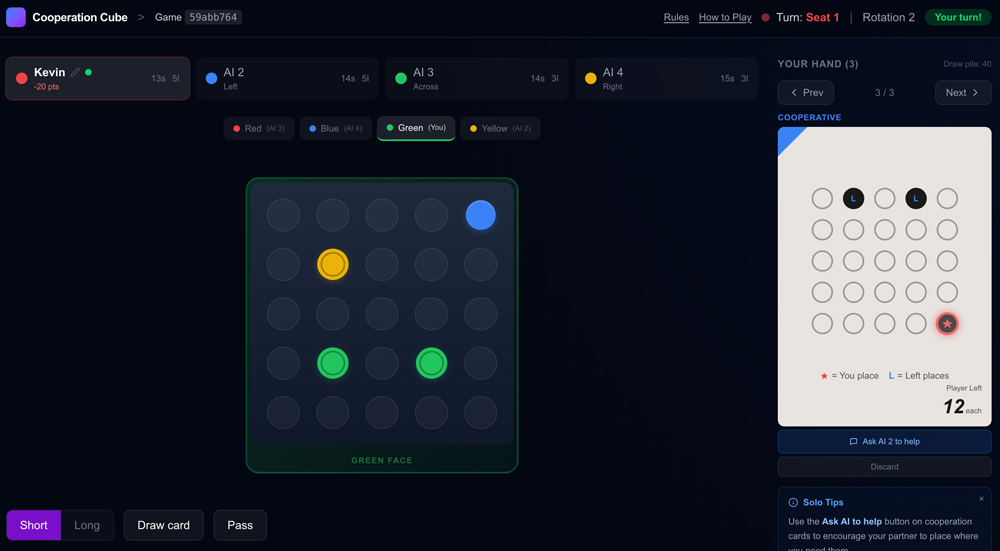
In most games you can track the leader as you play. You see the money pile grow, the score marker move, the checkpoints fall in a predictable order. Cooperation Cube does not work like that.
I launched the web version recently and the following are some insights based on the data and my time playing it so far.
One of the more interesting dynamics is that no one at the table knows who is winning until the game is over. Cards sit face down in your hand. Cooperation partners score silently. Bonus cards and endgame awards only settle at the very end. You can play for an hour and genuinely have no idea where you stand.
This pulls on you in a strange way. The impulse, carried over from every other game you have ever played, is to play defensively against whoever looks like they are ahead. In Cooperation Cube that impulse is wasted motion. You cannot measure a leader you cannot see. The only useful thing to do is play your own hand. Count your placements, complete the cards you can complete, and trust that the math takes care of the rest. It is harder than it sounds. The muscle memory of leaderboard-watching is strong.
The second thing I learned by counting was how little time you actually have. Games in the data have averaged 80.6 turns total. Four players means twenty turns each. The cube rotates every round, so those twenty turns split across four faces. Five turns per face. And the densest cards in the deck ask you to place sticks on five positions on a single face. The margin is exactly zero. If you aim for a five-placement card and spend even one of those turns on something else, the card is dead.
Two things rescue you from that math. The first is long sticks. A long stick is a beam that runs all the way through the cube, showing up on both the face in front of you and the face opposite, from a single action. If you are working a five-placement card, a well-chosen long stick does the work of two. The second is the discard pile. You only get one action per turn, and discarding a card that will not complete is one of them. Late in the game, giving up on a card is often the highest-value move on the board. The points you avoid losing are just as real as the points you score. Strategy ends up being as much about what you let go of as what you reach for.
The third insight is about the card most players treat as pure chaos. Switch seats swaps two players at the table. Your color, your hand, and your cards all travel with you, but the seat you sit in changes, and so do your turn order and the direction of your cooperation partners. Someone is having a good round, the card lands, the geometry resets, everyone in the chat groans. Looking at the replays, I used to file it under the same category.
Then I came across a game that changed my mind. A player had already finished a cooperation card that needed their partner across the table. They still held a second cooperation card in hand, this one requiring the partner on their right. They played switch seats and slid into the one chair that put the right partner exactly where they needed them. The finished across card did not depend on the new seating, so it stayed banked. The second card closed a few turns later. A move I had written off as chaos turned out to be a scalpel in the hands of someone who had been reading the board two moves ahead.
Three habits fall out of all this. Play your own hand when you cannot see the leaderboard. Count the turns you actually have, and spend them on what is possible. Look for second-order moves that other players have stopped considering.
Try it yourself at cooperationcube.com, solo against AI or with friends.