Documentation delay
After looking at the batching patterns in Ambiki's visit note data, I wanted to zoom out. Forget when notes are submitted relative to each other. How long after a session does the note actually get written?
The median gap between a session and its visit note is 4 hours. About a third of notes (33.8%) are written within an hour of the session. After that, completion slows. Only 55% are finished same-day. By 24 hours, you're at 64%. By 72 hours, 73.5%.
The average is 72 hours, dragged upward by a long tail of notes written days or even weeks later (12.7% of notes aren't written until more than a week after the session happened).
Where do you fall in that distribution?
Timing is one side of it. Length is the other. The median visit note is 131 words. The average is 171. For context, this post is around 430 words.
SOAP notes run the longest at a median of 159 words (average 205). Free text notes land at 119 words median. DAP notes are the most concise at 55 words median.
If productivity pressures, back-to-back scheduling, and the rest of daily logistics were off the table, what would be the ideal length for a visit note? Does that change depending on the session or the type of therapy?
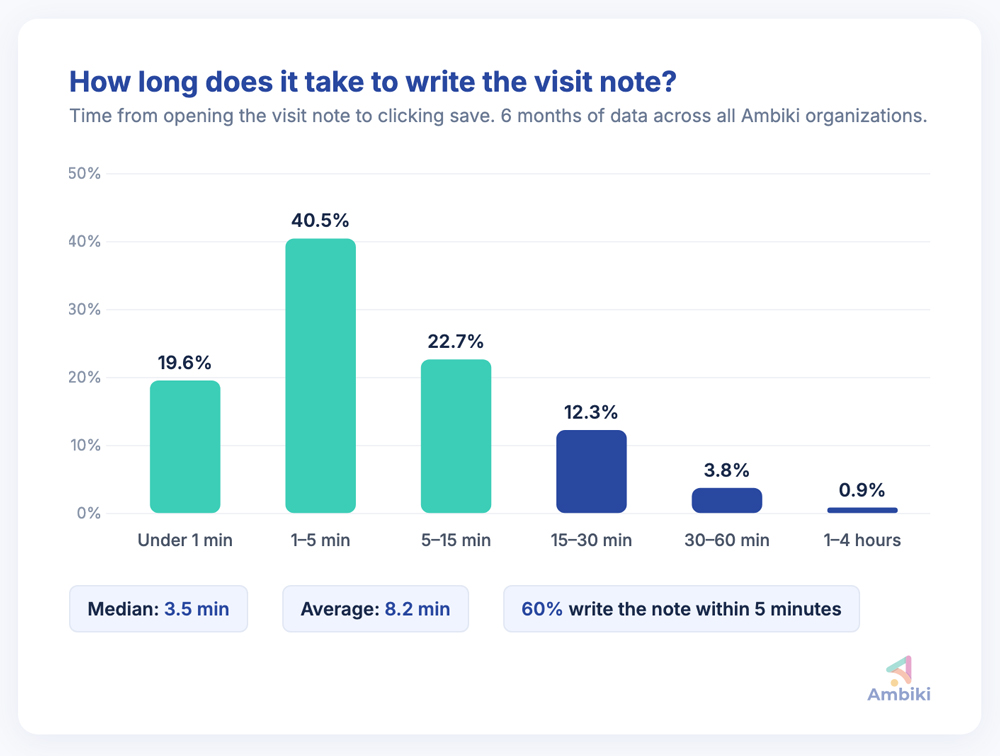
Once a therapist sits down to write, the note itself comes together quickly. The median time to create a note is 3.5 minutes. The average is 8.2 minutes. 60% of notes are finished within 5 minutes of starting. About 20% take under a minute. Only 5% take longer than 30 minutes.
This is the part that sticks with me. Three and a half minutes to write, but four hours (or seventy-two) to get around to it. The friction lives in everything surrounding the task: the next kid walking in, the parent phone call, the insurance question, the lunch you forgot to eat.
That tells me something about where the real opportunity is. Notes are already relatively fast to write. AI assistance will probably continue to bring that number down, but there is a floor. Below it, the therapist is no longer critically thinking, editing, or checking. The gap between session and documentation is where the time goes. One could reason that the closer the note lives to the session, the more accurate it is and the less mental energy it costs. But does that match your experience? What would actually help you close that gap?