Local dialect
When you join a new company or enter a new industry, one of the most important skills is listening.
Every company has its own language. Every industry has its own terminology. And beyond the official definitions, there's usually a whole local dialect you have to learn.
The acronyms. The shorthand. The words people use interchangeably (but maybe shouldn't). The tiny distinctions that seem meaningless to an outsider but matter a lot to the people doing the work every day.
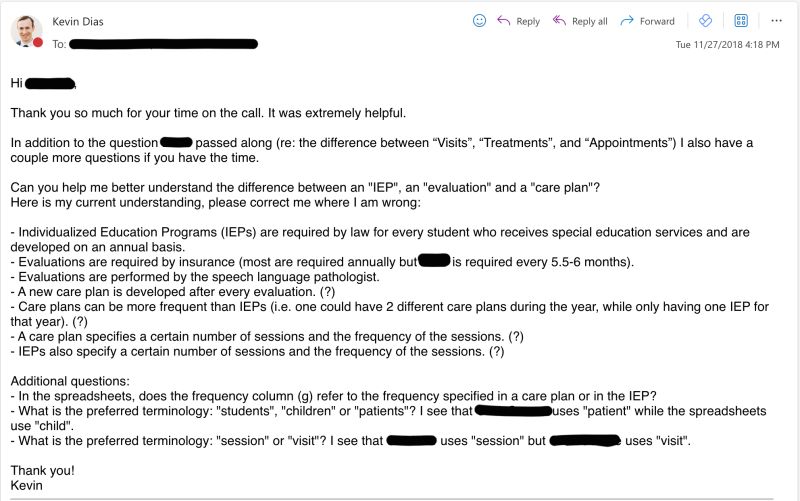
For example, when I joined a speech therapy company in 2018, it meant learning things like "students" vs. "children" vs. "patients" vs. "kiddos," and "visits" vs. "treatments" vs. "appointments."
The faster you learn that language, the faster you can actually understand the problems.
One advantage of joining a new company or industry is that you come in with a fresh perspective. If you don't know that something has "always been done this way," you're a little less likely to accept that it has to keep being done that way.
But there's an important prerequisite to questioning the status quo: you have to understand it first.
So I asked a ridiculous number of questions. And looking back over my career, a lot of my education has happened one email, support ticket, conversation, and dumb question at a time.
Being new can be an advantage. But only if you're willing to listen and learn the language before trying to change it.