Since 1494
As one commenter pointed out on a previous post: “Double-entry accounting has been around since 1494, and most practice management systems have been auto-posting 835s for 20 years.”
Fair point! So what makes Ambiki's ledger different? Well, I'm glad you asked.
Actually, figuring out how to articulate that has, in some ways, been harder than building the thing.
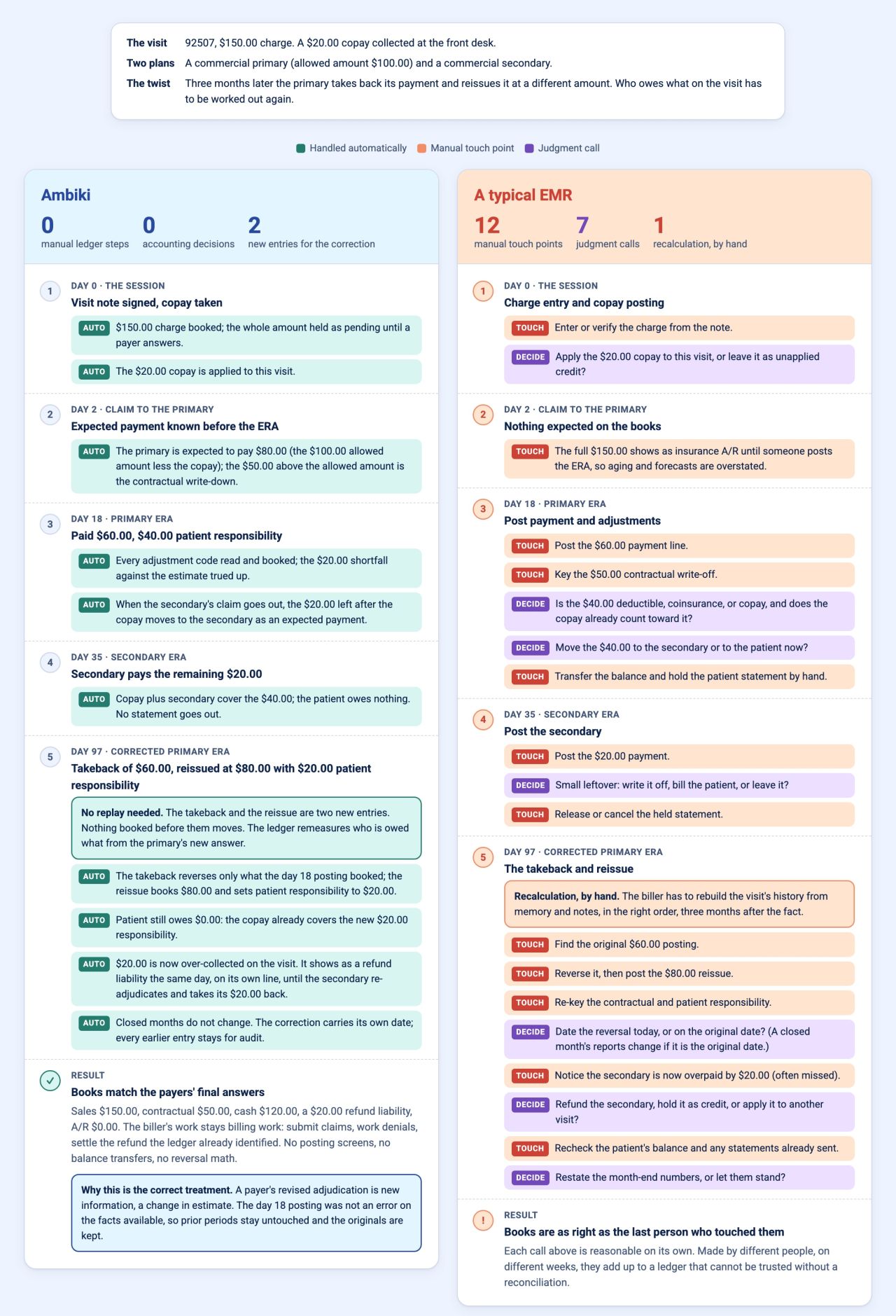
Then I had an idea. What if we showed, side by side, all the manual touchpoints and accounting decisions required to handle a complicated billing scenario in a typical EMR versus Ambiki?
So the image below has an example: 12 manual touchpoints and 7 judgment calls versus 0 in Ambiki.
“Oh, well, Kevin. Thanks for cherry-picking one complicated scenario.”
Actually, 11% of all visits in Ambiki required a recalculation. Or in other words, something done automatically in Ambiki that would have required manual steps in another EMR. For visits involving copays or coinsurance, that number approaches 1 in 5. These aren't rare edge cases. They're everyday billing situations.
Think about how much manual work that represents for billing teams. But it's not just about saving time. Accuracy and consistency are the main reasons we built this.
Even the best billers in the world can struggle with these situations. A payment gets reversed three months later. Patient responsibility changes. A secondary insurer has already paid. Now what?
There are a dozen places where someone could make a mistake, overlook something, or simply handle it differently than the person sitting next to them.
And remember, billers are billing experts, not accountants. They shouldn't have to reconstruct three months of accounting history to figure out what a patient owes. Ambiki applies the same accounting rules, the same way, every single time. No manual recalculations. No guesswork. No wondering whether someone remembered to update a balance.
That's what makes our ledger different. The accounting principles may date back to 1494, but the engine we've built is designed specifically for the reversals, adjustments, secondary payers, and endless curveballs of American healthcare billing.