Untimed code
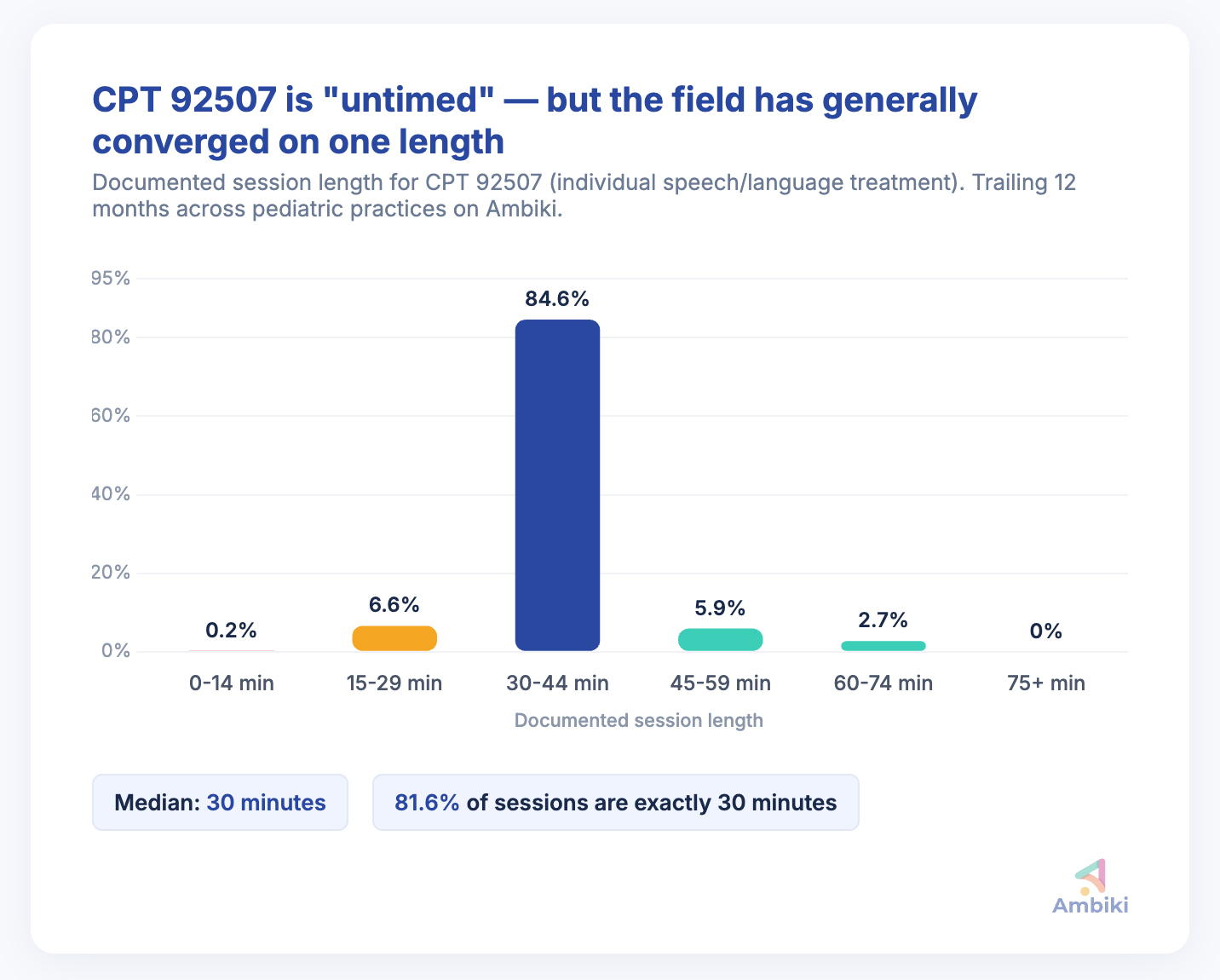
CPT 92507 is the workhorse code for individual speech-language treatment, and it is untimed. A 30-minute session and a 45-minute session both live under the same code.
That is expected to change in 2027, when 92507 gets replaced by a new speech treatment code structure. The final reimbursement details are still not known, and 92507 remains active for now.
So I pulled the last 12 months of 92507 sessions on Ambiki to see what pediatric SLPs are actually delivering today.
Across the dataset, the median session was 30 minutes. 81.6% of all sessions were documented at exactly that length, and 30 minutes was the median for 77.8% of practices. The standard deviation was 6.4 minutes.
That is a tight distribution for an untimed code. The field has already converged on 30-minute individual treatment sessions as a de facto standard, even though nothing in the code itself requires it.
A smaller group, around 20% of practices, typically delivers longer sessions, often 45 or 60 minutes. That may reflect intensive caseloads, specialty models, different populations, or a different clinical philosophy.
The 2027 change will hit those two groups differently. A practice running 30-minute sessions probably maps cleanly into a timed structure. A practice built around 45 or 60-minute sessions has more to figure out about how the new operational and reimbursement details will shake out for them.
A billing code change like this one ends up touching the actual structure of clinical work. Worth following through 2027.