The Putter King Chronicles (Part 2 of 5)
Hustle
This is part 2 of a 5-part series on Putter King.
Part 1: Hope · Part 2: Hustle · Part 3: Crisis · Part 4: Transformation · Part 5: Full circle
There's a moment in every project where it stops being an idea and starts being a thing you have to actually do. For Putter King, that moment was the day I walked into an accountant's office in Tokyo and said, in my best Japanese, that I wanted to start a company.
The accountant looked at me the way accountants look at people who are about to make their lives complicated.
"What kind of company?"
"A miniature golf company."
He wrote something down. I couldn't read his handwriting, but I imagined it said: Foreigner. Miniature golf. Proceed with caution.
Incorporating in Japan as a foreigner was an exercise in patience. There were forms for the forms. The legal attorney explained the different company structures (kabushiki kaisha, godo kaisha) and I chose the one that sounded most like a real business and least like I was playing pretend.
The trademark came next. Putter King. Two words that meant nothing in Japanese and everything to me. Filing the trademark made it official in a way the notebook never had. This wasn't a hobby anymore. There was paperwork.
The whole process took weeks, then months. Stamps, seals, registered addresses, bank accounts. Every step felt simultaneously too serious for what I was building and not serious enough. The company was for the franchise, indoor adventure golf courses across Japan, but the first product would be an app. A stepping stone, I kept telling myself. Build the game, build the brand, then build the courses. The absurdity wasn't lost on me.
But every form I signed made it more real. And real was what I wanted.
Years later I'd read Paul Graham's essays and recognize a term for what I was doing: playing house. Founders who spend their time on logos, business cards, and corporate structures instead of the terrifying work of talking to customers and finding out if anyone actually wants what you're building. Every stamp and seal had felt like progress. It wasn't. But I wouldn't understand that for a long time.
Patrick delivered the logo first.
I'd described what I wanted in the vaguest possible terms: friendly, playful, something a kid would want on a t-shirt. Patrick, being actually talented, ignored most of what I said and designed something better than what I'd imagined.
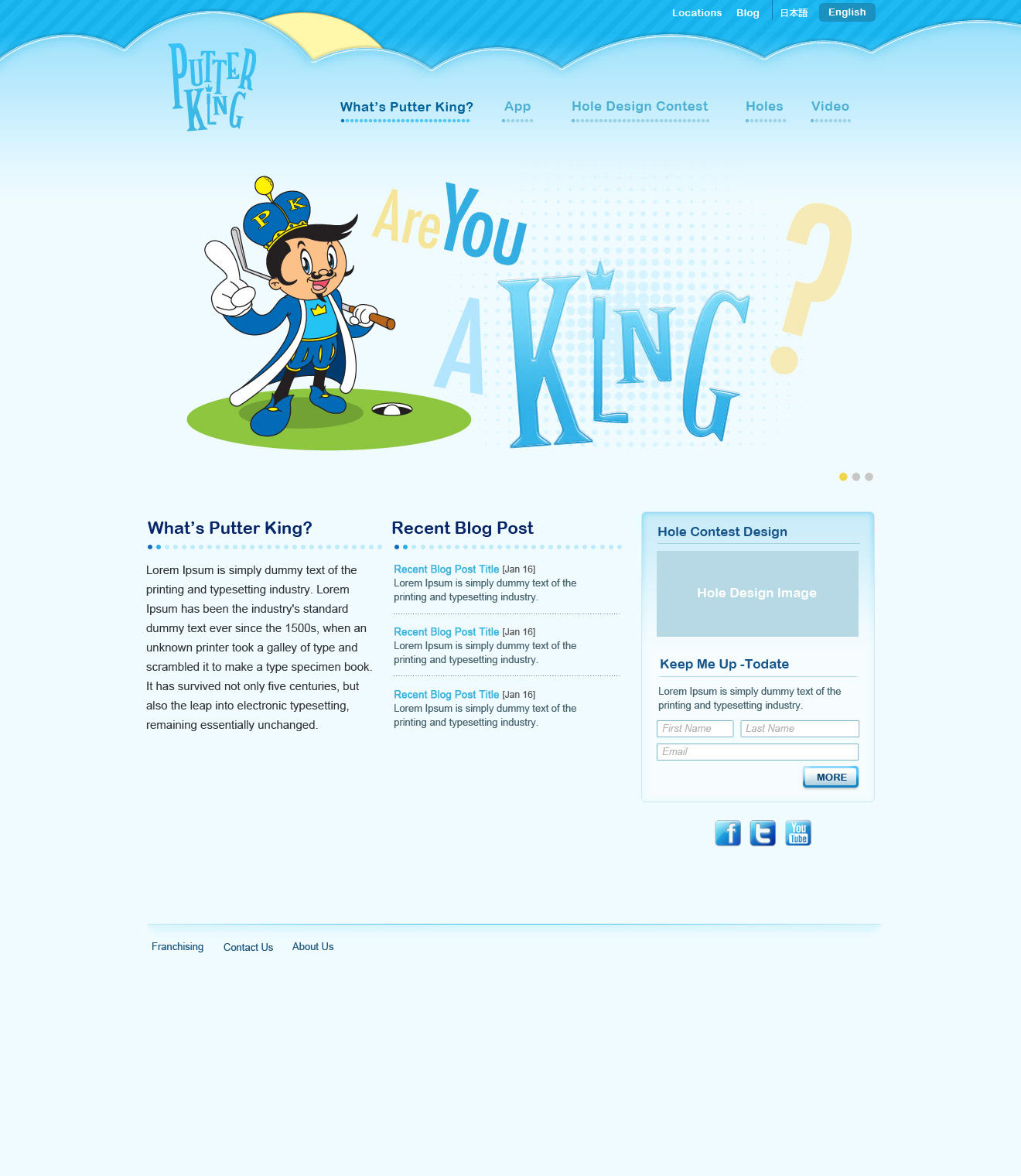
The mascot character emerged over a few rounds of sketches. A little figure with a crown, holding a putter, radiating the kind of earnest enthusiasm that makes you smile before you understand why. Patrick captured something I couldn't articulate: the feeling of miniature golf itself. Not competitive. Not serious. Just fun.
When I saw the final version, I had one of those moments where the thing in your head meets the thing in the world and they match. The mascot looked like it had always existed, like Patrick had found it rather than created it.
"That's him," I said. "That's the Putter King."
Evan Burkosky built the website. Drupal, because it was 2010 and Drupal was what you used. The domain was putterking.com.
The site went live and suddenly Putter King had a presence. A real URL. A logo. A mascot. An "About" page that described a company that technically existed, even if it consisted of one English teacher and a notebook of hole designs.
I remember refreshing the site from my phone on the Yamanote line, just to watch it load.
The infrastructure of a real business was taking shape around an idea that still lived mostly in my head. But it was moving. Every week, something new appeared that hadn't existed before. A logo file. A web page. A registered trademark. The dream was calcifying into reality, one artifact at a time.
The app itself was the problem I couldn't solve alone.
I'd been designing holes in Google SketchUp, the free version before Google sold it off, drawing curves and ramps and obstacles the way an architect might sketch a building they'd never construct. The designs were good. I knew they were good because I could see them, could feel the physics of how a ball would roll through each one.
But I couldn't code. And a miniature golf game for the iPhone needed code. 3D graphics. Physics engines. Touch controls. Everything I couldn't do.
So I started looking for a developer.
This was January 2011. I found a development shop I'll call SocialJunction through an online search. They promised 3D game development for iPhone, iPad, and Android. The contract was $4,500 for a complete miniature golf game. They assigned a developer and a project manager. (I've changed the names of both development companies in this story. They don't deserve the publicity.)
$4,500. It felt like a fortune and a bargain at the same time. I signed the contract on January 11th and wired the money, and for a few weeks, the future felt impossibly close.
But the app wasn't the only thing taking shape.
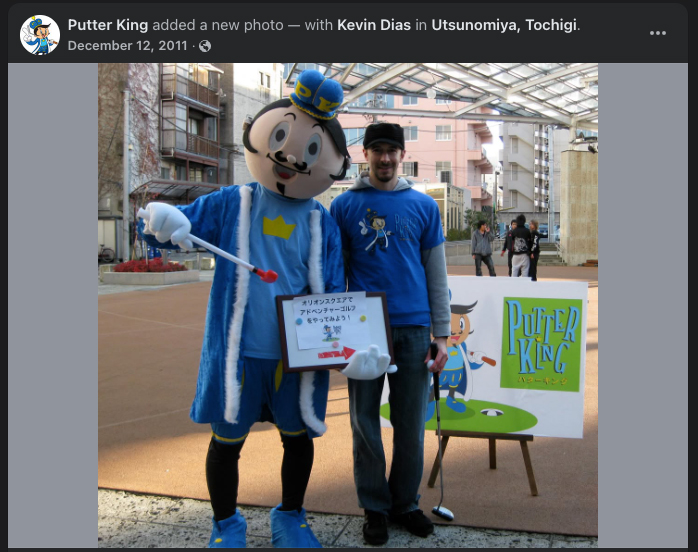
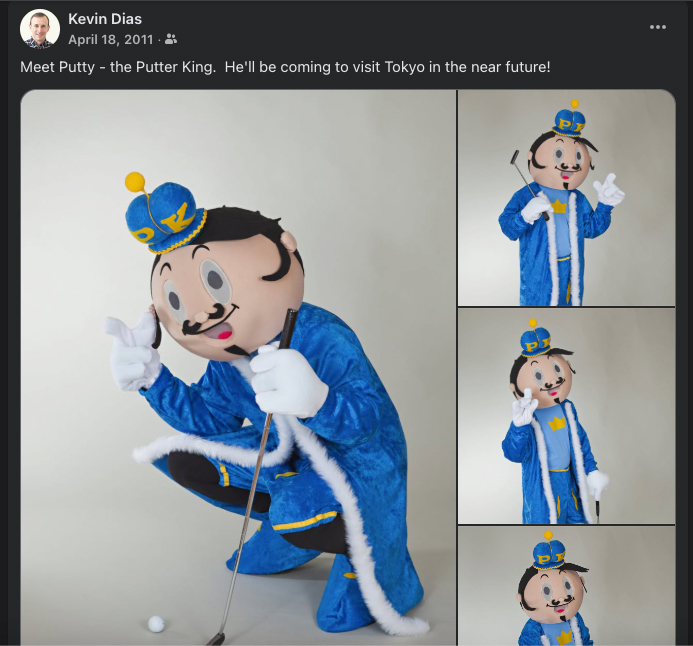
The mascot arrived in Japan sometime that spring.
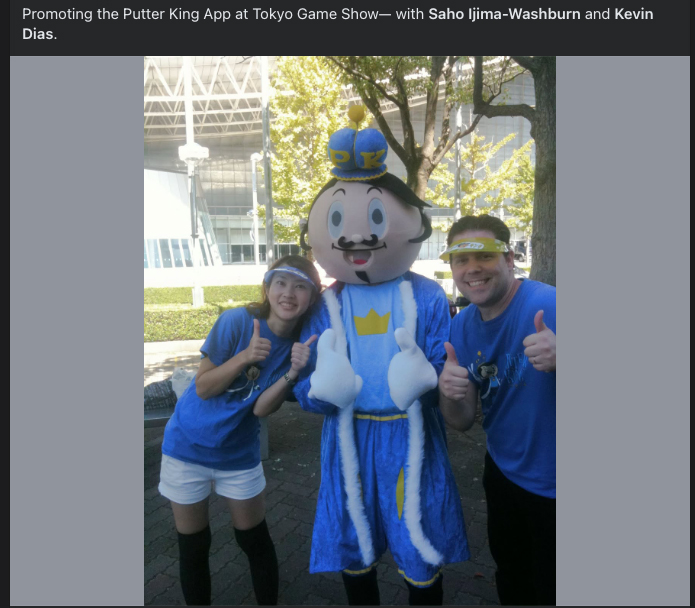
Not the digital one. The physical one. A costume. Life-size. The Putter King character that Patrick had designed, rendered in fabric and foam, with a crown and a putter and that same earnest smile.
My mom had designed and made it back in the States and shipped it to Japan, because, well, because that's who she is — she'd support whatever I was trying to do, no matter how strange it sounded. Because the logo on a website was one thing, but a mascot that could stand next to people and wave? That was real in a way that pixels never would be.
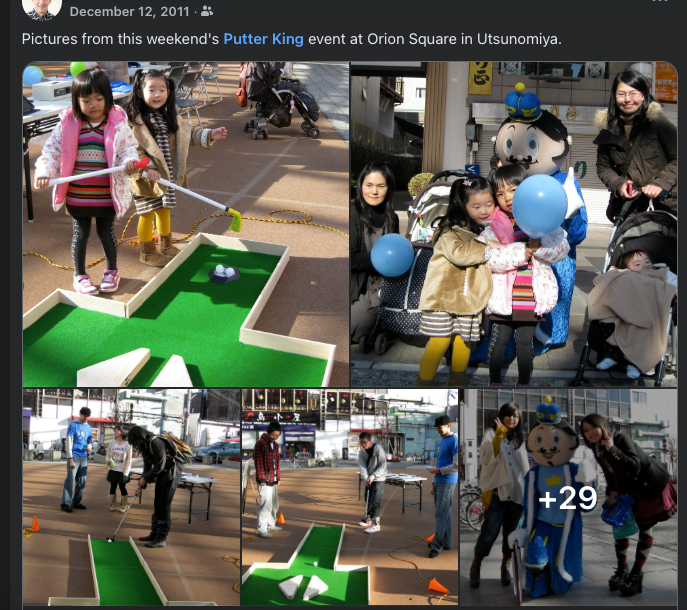
Golden Week, May 2011. Mari and I took the mascot (Putty, we called him) to Nikko. The famous shrines. Tourists everywhere. And there, in the middle of a UNESCO World Heritage Site, stood a six-foot miniature golf mascot that absolutely no one had asked for.
The kids went crazy.
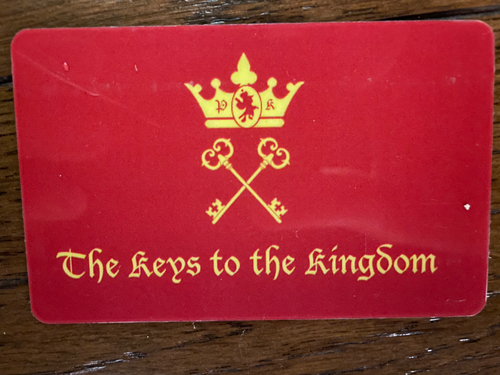
They lined up. Actual lines. Pulling their parents by the hand, pointing at Putty, posing for photos. The parents laughed and took pictures and asked what Putter King was. I handed out cards and explained, trying to sound like someone who ran a real company and not someone who was sweating through a foam costume in May humidity.
My Aunt Vera had been following the Putter King updates from the States.
I wrote her back about Nikko: how we'd gone to a hidden part of the World Heritage site just to shoot some pictures, and within five minutes people were lining up. How we could have kept going for an hour. How the little kids came up asking to have their picture taken with the mascot, and they were so cute.
Writing that email, I felt something I hadn't expected. Not pride, exactly. More like recognition. Someone in my family was paying attention to what I was building, and it was worth telling her about.
And then there was the music.
Hiroki Fujii was one of my English students at AEON in Kanda. Quiet, thoughtful, the kind of person who listened more than he spoke in class. What I didn't know at first was that he was a professional musician. When I told him about Putter King, about the game and the holes and the whole improbable enterprise, he didn't nod politely the way most people did. He leaned forward.
"I could compose the soundtrack," he said.
He meant it. Over the following weeks, Hiroki composed and recorded the game's entire soundtrack in his studio. The music was better than it had any right to be for a miniature golf game built by an English teacher. It was playful and propulsive, the kind of soundtrack that made you feel like each hole was an adventure. Later, he invited me to a live show where he performed music from it on stage. Sitting in the audience, hearing the Putter King soundtrack played live, I had one of those moments where the absurdity of what you're building loops all the way around and becomes something real.
That spring was the high point.
Everything was in motion. The company was incorporated. The trademark was filed. The website was live. Patrick's mascot was greeting kids at Japanese tourist sites. Evan's site was getting traffic. Hiroki had composed an entire soundtrack. The SketchUp files were piling up with hole designs. SocialJunction was supposedly building the app.
I had a logo, a website, a mascot, a soundtrack, a developer, a company, and a dream that felt less like a dream every day.
On the Yamanote line, the notebook was filling with different kinds of notes now. Not just hole designs, but marketing plans. Launch strategies. Revenue projections scribbled in the margins. The numbers were probably fantasy, but the energy behind them was real.
It felt like building a plane while flying it. Terrifying and exhilarating and somehow working, one piece at a time, held together by momentum and belief.
I didn't know yet that SocialJunction would never deliver. I didn't know about the developer who would take fifteen thousand dollars and walk away. I didn't know about the earthquake that was coming, or the move it would force, or the conversations with my dad where he'd ask, gently, whether it was time to stop.
All I knew was that Putty was making kids smile in Nikko, and the app was almost ready, and everything, everything, felt possible.
That's the thing about momentum. It feels like proof. Right up until it doesn't.
This is part 2 of a 5-part series.
Part 1: Hope · Part 2: Hustle · Part 3: Crisis · Part 4: Transformation · Part 5: Full circle