The Putter King Chronicles (Part 4 of 5)

Transformation
This is part 4 of a 5-part series on Putter King.
Part 1: Hope · Part 2: Hustle · Part 3: Crisis · Part 4: Transformation · Part 5: Full circle
It was early 2012, and I was staring at a spreadsheet that told me exactly what I already knew.
App downloads for Putter King Adventure Golf had barely moved. The marketing campaign I'd spent months designing, a global scavenger hunt with trick shots, autograph hunts, and elaborate point systems, had done nothing for sales. The app had launched in October. The hunt had crowned a champion in November. And the numbers hadn't budged. The app had won third place for Best Sports Game for Android in the 2011 Best App Ever contest, plus an honorable mention for Best Kids Game. Critics noticed. Customers didn't.
I didn't care.
Something else had happened. Something in the comments. In the emails. In the corners of the internet I hadn't expected anyone to find.
The scavenger hunt had started as a launch strategy.
After the Leon Sharp disaster, after the threatening emails and the extortion attempts, after watching months of momentum disappear, I'd cut out the middleman and started working directly with the developer who'd been building the game all along. The app was real. It was coming. But I needed something to build buzz, something that would reach the kind of people who might actually care about a miniature golf game.
So I built a scavenger hunt.
I sat in my apartment in Tochigi and wrote out seventeen tasks. Some were straightforward: "Picture of yourself with at least 6 different colored miniature golf balls." Some were ridiculous: "Get autographs from professional miniature golfers from two different countries." Some bordered on insane: "Build your own full-size miniature golf hole."
1,370 total points available. Bonus points for absurdity. I published the list on August 26th, 2011, two months before the app would hit the App Store, and waited.
What I got back was something I still struggle to explain.
The first serious entry came from Richard Gottfried, a British Minigolf Association Tour Pro from Luton. Not a casual player, but a champion. Someone who'd won the Blackpool Pleasure Beach Open, the Weymouth Open, the Manchester Mini Major. He and his wife Emily had played over 900 crazy golf courses across the UK and Europe. They were blogging about their travels.
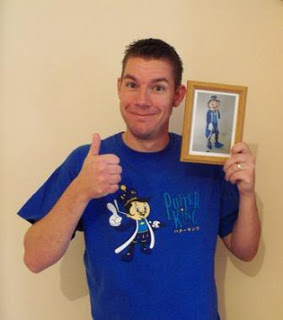
Richard didn't just participate. He documented.
He photographed himself next to every nostalgic obstacle on my list: the windmill, the loop-de-loop, the lighthouse, the cannon. He built a full-size miniature golf hole called "PK Island" in his backyard on October 24th and 25th, complete with a plateau and ramp obstacle, and filmed himself playing it. He completed the Putter King math and physics lessons I'd designed as educational content, submitting detailed worksheets. He collected autographs from international players, including five-time World Crazy Golf Champion Tim "Ace Man" Davies from Wales. He took the Putter King wobblehead to the Jurassic Coast, a UNESCO World Heritage Site.
For the trick shot task, he filmed himself sinking a hole-in-one while wearing a blindfold at Tea Green Golf Club near Luton.
Reading his entry logs felt like watching someone take this contest more seriously than I had treated anything up to that point. He finished with 15 of 17 tasks completed. 820 points.
I thought: This man might be the most dedicated human being I've ever encountered.
Then I heard from Australia.
Allan Cox was fifty years old and a member of the Ermington Putters Club in Sydney.
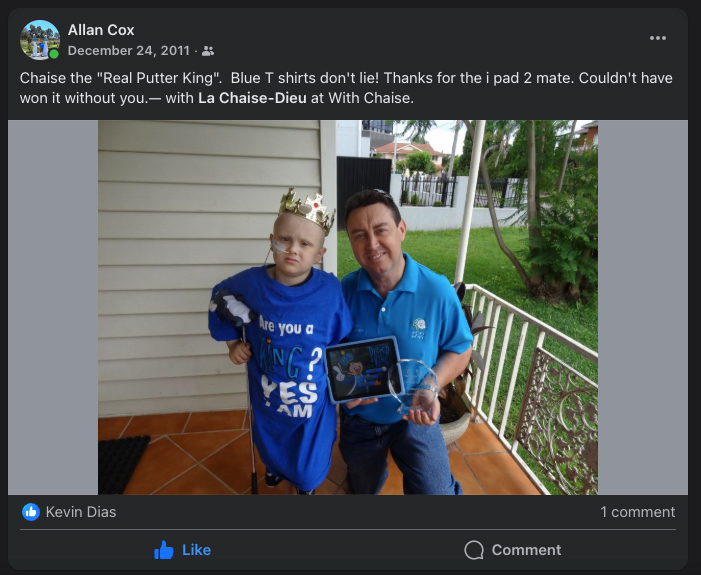
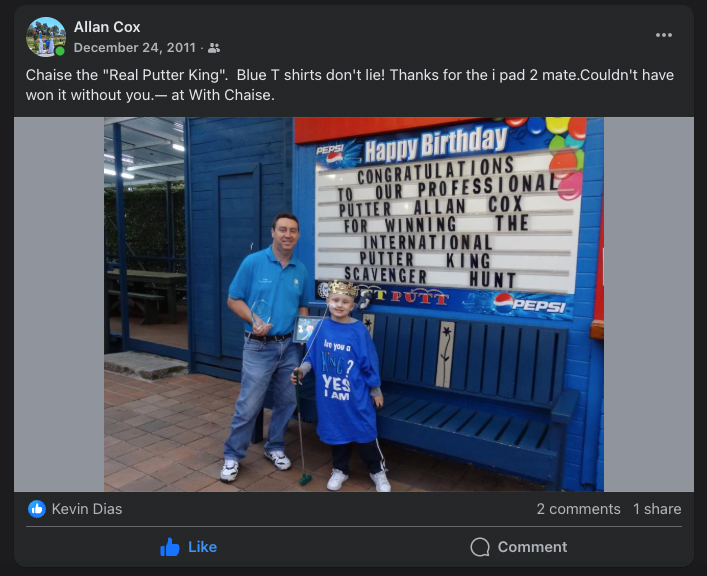
Allan wasn't just completing tasks. He was becoming the Putter King. Not as a bit. Not for laughs. He adopted the identity like it was something he'd been waiting for his whole life.
For his trick shot, Allan set up at Putt Putt Ermington with two ramped holes. The ball traveled 18 meters from tee to cup, sailing 1.2 meters in the air. It was the kind of shot that shouldn't work, physics stretched past plausibility, and then it dropped in.
He posted it to YouTube with a kind of enthusiasm you can't fake.
"Having a ball, no pun intended, with the Putter King Scavenger Hunt," Allan wrote on Facebook. "UK opposition very very tough. Need all the votes I can get. Hop aboard the PKSH express and enjoy the ride. It's been fun so far, who knows when it will end."
Meanwhile, across the Pacific, Pat Sheridan was mounting his own campaign. He ran The Putting Penguin, the largest miniature golf course review site in the world. Three countries. Three competitors going all out for a trophy I'd designed in my apartment and a t-shirt I'd had printed at a local shop.
When the hunt closed on November 1st, 2011, Richard and Allan were tied at 820 points each. Pat trailed in third with 585, still an impressive haul for a contest I had originally framed as niche marketing.
I hadn't planned for a tiebreaker. So I made one up.
The 17th task, "Video of yourself successfully making a trick miniature golf shot," would go to a public vote on the Putter King Facebook page. Whoever got the most votes by November 13th would be crowned champion.
Richard's blindfolded ace versus Allan's 18-meter ramp shot.
The final count: Allan Cox, 212 votes. Richard Gottfried, 89.
A man from Australia had just won a global scavenger hunt I'd created by popular acclaim.
Allan's final point total: 960. Richard: 900. Pat: 585.
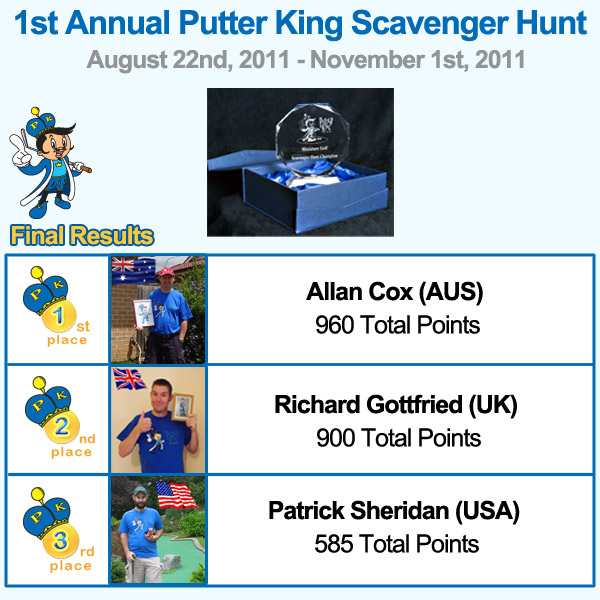
I remember sitting in my apartment, staring at the numbers, thinking: This is the strangest thing I've ever been part of.
"It has been a whole heap of fun," Allan wrote after the results came in. "I have had a ball."
The trophy arrived in Australia a few weeks later. "Unceremoniously left under my front door mat by an uncaring Australia Post!" Allan posted. "They have no respect... lol."
He was already planning a victory tour. "Looking forward to donning the blue T-Shirt and visiting all the mini golfs that played their part in the come from nowhere victory, for some photo opportunities. Yes before I get all the comments... I am full of it. Not quite sure what? But I am full of it. LMAO."
Richard, ever gracious, posted his congratulations: "Many thanks to the Putter King team for organising such a brilliant contest. I dread to think what lengths they'll have us going to in next year's contest!"
There would be a next year. Companies like Putterfingers came on as sponsors. The community that had formed around seventeen over-the-top tasks didn't dissolve. It deepened.
Allan took that Putter King identity and ran with it. He launched a YouTube channel called PuttPuttdownunder. One video hit over 4 million views. Million. He used the attention to raise money for the Children's Hospital at Westmead and Bear Cottage.
In 2012, he set a world record for most miniature-golf hole-in-ones in a 24-hour period: 1,516. That worked out to 175 rounds and, by his own estimate, roughly a marathon's worth of walking. He did it while raising funds for the Oncology Department at The Children's Hospital at Westmead.
Richard and Emily continued touring courses across the UK and Europe. Richard would eventually set his own Guinness World Record for most miniature golf courses visited.
Pat kept building the Putting Penguin community in the States. Three countries, three competitors, three people who found something they didn't know they were looking for.
I wasn't sure this would sell apps.
Mini golf enthusiasts weren't going to suddenly become iPhone gamers. The Venn diagram barely overlapped. That was never really the point.
I built the scavenger hunt because I wanted to see what would happen. Because after the scammers and the threatening emails and the countertop reality checks from my dad, I needed to make something that wasn't about ROI or investor updates or proving I could escape teaching.
I needed to make something for the making.
What I didn't expect was how far it would travel.
I created a contest. Allan found a persona that let him channel obsession into charity. Richard took something he already loved and pushed it further. Pat found community across an ocean. Three strangers from three continents formed something real around something as unlikely as competitive miniature golf, and that something outlasted the app that spawned it.
The least successful marketing campaign I ever ran. Also the most rewarding.
Some things don't fit in a spreadsheet. Maybe the best things never do.
The scavenger hunt ended warm. A community had formed. People had found something real in something unlikely. It would have been a fine place to stop.
The harder truth was underneath all of it: the app didn't fund the franchise. The downloads never came. The dream of indoor adventure golf courses in Kanto, the warehouse near Oyama, the eighteen holes I'd sketched on the Yamanote line. None of it came back around. The scavenger hunt was beautiful, but it wasn't a business model. The stepping stone never led back to the staircase.
I sat with that for a long time. Not the failure of the app. I'd made my peace with the spreadsheet. What I couldn't shake was the deeper thing. The thing that had been true since SocialJunction's first email, since Leon Sharp's threatening emails, since every check I'd written to someone else to build the thing I'd imagined.
I had always been at someone else's mercy.
Every version of the dream had depended on someone else's hands. The developers who took the money. The developer who finally delivered. The investors I couldn't bring myself to ask. The franchise model that required capital I didn't have and expertise I couldn't provide. The app that existed only because Tasty Poison Games had the skills I lacked.
The notebook was full of ideas. I couldn't build any of them myself.
That was the real lesson Putter King taught me. Not that dreams fail (I already knew that). But that I was never again going to be at the mercy of someone else building something for me.
So I learned to code.
Not overnight. Not in a montage. In the slow, unglamorous way that people actually learn things: nights, weekends when I should have been resting, tutorials that made me feel stupid, projects that broke in ways I couldn't understand, then broke in ways I could.
The first things I built were terrible. Truly, impressively bad. The kind of code that would make a real developer wince. But they were mine. Every line. Every bug. Every deployment that crashed and every fix that followed. No one could send threatening emails about my own skills. No one could walk away with my ability to ship.
I shipped something. It failed. I learned why. I shipped something else. It failed differently. I learned that too.
The notebook that had started with franchise blueprints, then became app designs, then became scavenger hunt tasks, now filled with something new. Code snippets. Database schemas. Architecture diagrams drawn by someone who was finally learning to build the things he'd only ever been able to imagine.
It took years. There was no single moment where I crossed from outsourcer to builder. It was more like the Yamanote line: you go around enough times, and one day you realize the view has changed completely.
I stopped drawing holes for courses that would never exist. I started building software that did.
The Putter King franchise never happened. The warehouse near Oyama is probably still empty, or maybe it's a storage facility now, or someone's workshop. The business plan with its ¥19.5 million buildout cost sits in a folder I haven't opened in years.
The thing Putter King broke open in me, the stubbornness, the willingness to look foolish, the conviction that the idea in my head deserved to exist in the world, never closed back up. It just found a different outlet.
The person who incorporated a miniature golf company in Tokyo would barely recognize the person writing this. Different career. Different skills. Same notebook habit, though. The same compulsion to fill blank pages with things that don't exist yet.
The difference is that now, when I fill those pages, I can build what I draw.
That's what Putter King became. Not a franchise. Not an app. A reason to learn the thing I should have learned from the beginning.
The transformation wasn't dramatic. It was just someone who got tired of writing checks to other people and decided to write code instead.
This is part 4 of a 5-part series.
Part 1: Hope · Part 2: Hustle · Part 3: Crisis · Part 4: Transformation · Part 5: Full circle